Jefferson County, Mississippi
A Proud Part of the Mississippi GenWeb!
Contact Us:
State Coordinator: Jeff Kemp
County Coordinator: Gerry Westmoreland
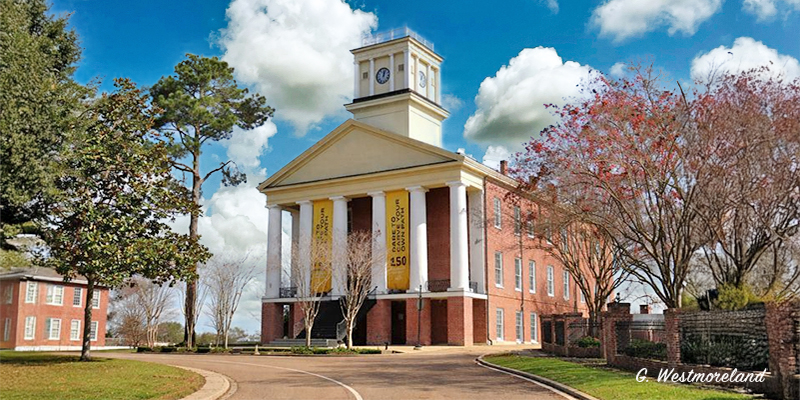
Alcorn State University, located in Lorman, Mississippi, is the oldest public historically Black land-grant university in the United States. Its origins date to the turbulent years following the American Civil War, when education for formerly enslaved African Americans was both a necessity and a point of contention in the Reconstruction South.
The institution was founded in 1871 as Alcorn University, named in honor of James Lusk Alcorn, a former Mississippi governor and U.S. senator who supported public education for African Americans during Reconstruction. The university was established on the site of Oakland College, a former Presbyterian institution for white males that had ceased operations during the war. Under Mississippi’s Reconstruction government, the campus was repurposed to serve the educational needs of Black citizens, a bold and progressive step for the era.
Alcorn University officially opened on May 1, 1871, with a mission to provide higher education, teacher training, and practical instruction to African American men. The curriculum initially emphasized agriculture, mechanics, teacher education, and classical studies, reflecting both land-grant principles and the urgent need for trained Black educators in Mississippi. Hiram Revels, the first African American to serve in the United States Senate, was appointed as the university’s first president, lending national significance and credibility to the fledgling institution.
In 1878, following political changes in Mississippi that ended Reconstruction, the university’s funding and governance were altered, but Alcorn survived—unlike many similar institutions nationwide. In 1890, the Morrill Act (Second Morrill Act) designated Alcorn as Mississippi’s land-grant institution for African Americans, ensuring federal support for agricultural, mechanical, and industrial education. That same year, the university officially became known as Alcorn Agricultural and Mechanical College.
Throughout the late 19th and early 20th centuries, Alcorn played a vital role in educating Black teachers, farmers, and professionals across Mississippi and neighboring states. Graduates staffed rural schools, churches, and community institutions, helping to build educational and civic infrastructure during the Jim Crow era. Despite chronic underfunding, segregation, and political pressure, Alcorn continued to expand its academic offerings and campus facilities.
In 1962, reflecting its broadened academic mission, the institution adopted its current name, Alcorn State University. During the Civil Rights Movement, the university became a center of intellectual and social engagement, producing graduates who contributed to education, government, business, science, and activism. Unlike some Mississippi institutions, Alcorn avoided major campus unrest, in part due to its rural location, but it remained closely tied to the broader struggle for equality and opportunity.
In the latter half of the 20th century and into the 21st century, Alcorn State University expanded its degree programs to include graduate education, nursing, business, sciences, and the arts. It became particularly well known for its School of Agriculture and Applied Sciences, nursing programs, and teacher education, maintaining its land-grant mission of research, extension services, and community outreach.
Alcorn State University has produced generations of graduates who have made significant contributions in education, politics, science, military service, athletics, and the arts. Among its most distinguished alumni is Medgar Evers, a civil rights leader and field secretary for the NAACP, whose work in Mississippi became central to the national Civil Rights Movement. Evers’ legacy remains one of the most powerful symbols of courage and sacrifice associated with the university.
Another prominent alumnus is Major General Robert G. Stanton, former Director of the National Park Service, who played a key role in preserving America’s natural and historic resources. Edwin R. King II, a civil rights attorney and activist, also studied at Alcorn and became a notable figure in Mississippi’s legal and political history.
In the fields of science and medicine, Alcorn alumni have distinguished themselves nationally. Dr. Clinton Donaldson, a leading figure in environmental science and education, and numerous physicians, engineers, and researchers trace their academic foundations to the university. Alcorn graduates have also served with distinction in the U.S. Armed Forces, including high-ranking officers in multiple branches.
The university has produced accomplished artists, musicians, and educators, many of whom have returned to Mississippi communities to teach, lead schools, and preserve cultural traditions. Collectively, Alcorn’s alumni network reflects the institution’s long-standing mission of leadership, service, and professional excellence.
Alcorn State University is rich in traditions that reflect its history, pride, and sense of community. One of the most enduring symbols of campus identity is the Alcorn State University Golden Jubilee Clock Tower, which stands as a central landmark and gathering point. The clock tower is closely associated with commencement ceremonies and milestone celebrations.
Another beloved tradition is Founders’ Day, observed annually to commemorate the university’s establishment in 1871. The celebration typically includes convocations, alumni events, and historical reflections that connect current students with the institution’s Reconstruction-era origins.
Music and performance play a vital role in campus life, most notably through the Sounds of Dyn-O-Mite Marching Band. The band is nationally recognized for its precision, musical excellence, and role in enhancing school spirit at athletic events and public performances. Its presence has become a defining feature of the Alcorn experience.
Homecoming is among the university’s most anticipated events, drawing alumni and visitors from across the country. The celebration includes parades, step shows, reunions, athletic competitions, and cultural programming, reinforcing lifelong connections between graduates and the university.
Alcorn State University competes in NCAA Division I athletics as a member of the Southwestern Athletic Conference (SWAC). The university’s athletic teams, known as the Braves, have a long history of success, particularly in football. Alcorn’s football program has won multiple SWAC championships and has produced players who advanced to professional football and coaching careers.
A defining moment in Alcorn athletic history occurred in 1976, when the Braves, under the leadership of head coach Marion Campbell, defeated the University of Southern California (USC), one of the most storied programs in college football. The victory remains one of the most celebrated upsets in college football history and brought national attention to the university.
Beyond football, Alcorn has maintained competitive programs in basketball, track and field, baseball, softball, and women’s athletics, contributing to student development and institutional visibility.
Key institutional milestones include the expansion of graduate programs in the late 20th century, increased federal research funding tied to its land-grant mission, and continued investments in campus facilities and student services. The university celebrated its 150th anniversary in 2021, marking a century and a half of continuous operation—an achievement few institutions founded during Reconstruction can claim.
Today, Alcorn State University continues to serve students from Mississippi, across the nation, and internationally. As a historically Black university, it remains deeply connected to its founding purpose: providing access to quality education, fostering leadership, and contributing to economic and social development. Its long survival and continued growth stand as a testament to resilience, vision, and the enduring importance of education in shaping both individual lives and communities.